Japan's Immigration Services Agency recently proposed raising capital requirements for the “Business Management” residency status—intended for foreign entrepreneurs—to six times the current level, or “¥30 million or more.” The plan is in its final adjustment phase, with expert panel opinions to be gathered this month. Authorities aim to revise and implement relevant ministerial ordinances within the year.
The Business Management visa aims to attract entrepreneurs and enhance Japan's international competitiveness. However, criticism has arisen that its requirements are too lenient compared to other countries, leading to potential abuse. Consequently, the government has decided to tighten the criteria. Multiple Japanese government officials familiar with the matter disclosed this information.
Currently, the Business Management visa permits stays ranging from 3 months to 5 years (renewable) and allows family members to accompany the holder. Existing conditions include securing a business premises and meeting one of the following: “capital of at least 5 million yen” or “employment of at least 2 full-time employees.” Moving forward, the capital requirement will be raised to “at least 30 million yen,” and applicants must also “employ at least one full-time worker.”
Critics point out that some individuals, primarily Chinese nationals, have used this status as a means to easily relocate to Japan under the guise of operating private lodgings. Prime Minister Shigeru Ishiba stated in a Diet response that the criteria would be “appropriately adjusted.”
Japan's criteria have remained unchanged for 25 years.
The Business Management residency status requires establishing a business location in Japan and meeting conditions such as “capital of at least 5 million yen” or “employing two or more full-time staff” to be approved, allowing a maximum stay of five years. The number of holders doubled from approximately 18,000 in 2015 to about 39,000 by June last year, with Chinese nationals accounting for over half at roughly 20,000.
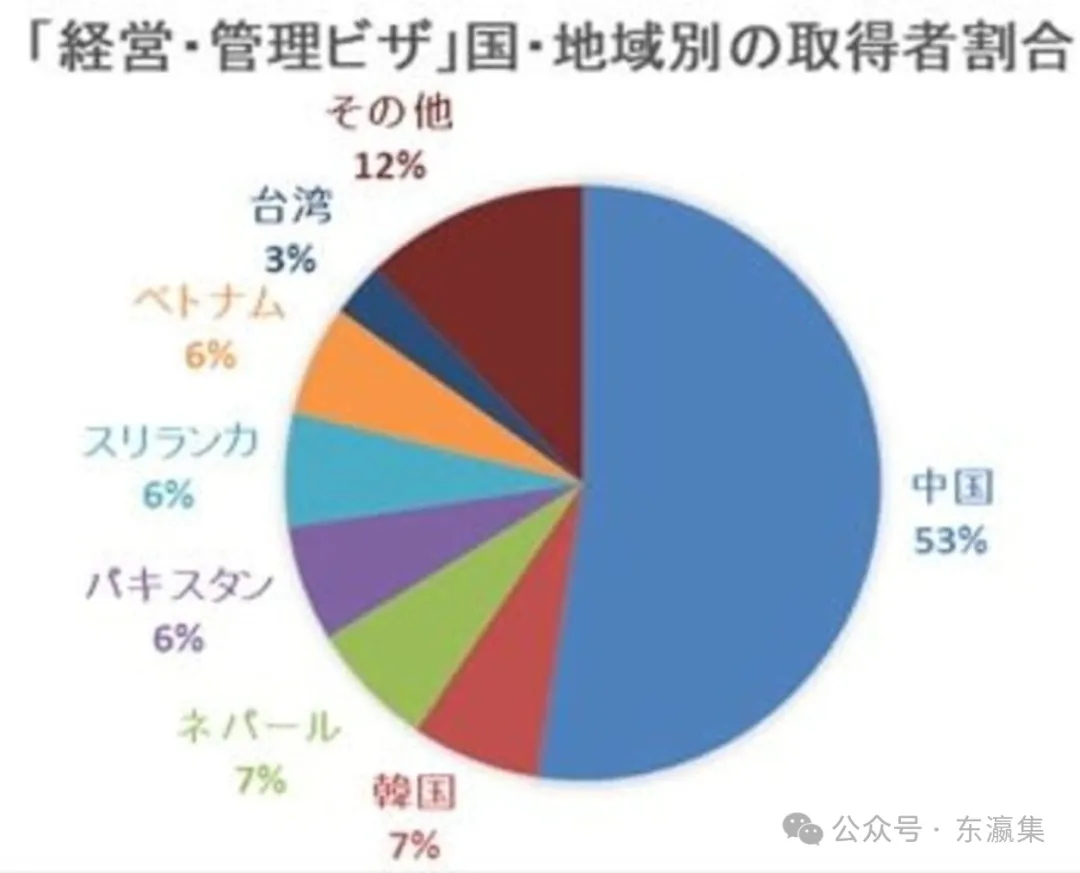
⬆Percentage of Business Management Visa Holders by Country/Region
However, the requirement for “capital of 5 million yen or more” has remained unchanged for 25 years since the “Investment and Management” qualification standards were established in 2000, and has been criticized as “far too low.”
Yuko Takegami, a member of Japan's conservative party, cited comparable standards from other nations: Singapore requires over 10 million Singapore dollars; the United States demands between 200,000 and 300,000 USD; and South Korea requires 300 million won. She proposed referencing the U.S. standard to raise Japan's current capital requirement to a more reasonable level.
Additionally, Australia requires applicants to possess a combined net business and personal assets totaling 1.25 million Australian dollars.
Accompanying Family Members Increases School Burden
During June's Senate Budget Committee session, Liberal Democratic Party member Satsuki Katayama stated: “The Business Management Visa requires no employees, no professional or educational background, no Japanese language proficiency assessment, and permits family members to accompany the applicant. Complaints are frequent about the significant burden placed on schools and other institutions by numerous children and parents who lack Japanese language skills.”
In response, Prime Minister Shigeru Ishiba acknowledged, “Compared to other countries, Japan's standards are relatively lenient. Criticisms that some individuals are immigrating under the guise of running guesthouses are indeed valid. The Immigration Bureau will appropriately adjust the standards going forward.”
Abuse Amidst the Homestay Boom
Operating a guesthouse only requires purchasing suitable property to meet the “business premises” requirement. Particularly in Osaka, the number of guesthouses has surged due to accommodation demand for the Osaka-Kansai Expo. In Tokyo's Harumi district, apartments converted from the Tokyo Olympic Athletes' Village are also suspected of illegal guesthouse operations.